Tech Manager at Asset Manager 'Praying' for Mifid II Delay
A technologist at Franklin Templeton Investments voices concerns about regulation.

The Markets in Financial Instruments Directive II (MiFID II) is due to be implemented Jan. 3, 2018, but at least one tech manager at an asset manager with over $733 billion in assets under management is hoping the regulation will be pushed back once again.
Oliver Grimsdall, IT manager at Franklin Templeton Investments, was clear on where he stands on the potential for MiFID II's implementation date getting a second extension.
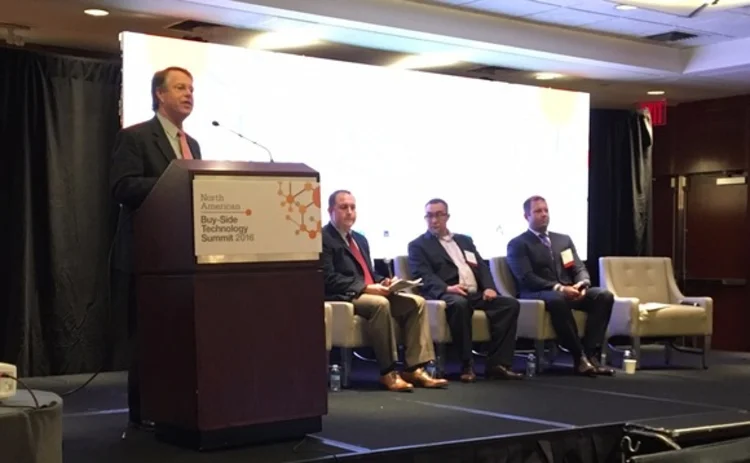
"I'm praying for it," said Grimsdall, speaking on a trade compliance panel at the North American Buy-Side Technology Summit 2016 in New York.
The topic was initially brought up by moderator Jay Wolstenholme, senior analyst in the securities and investments group at Celent, who asked the group about their biggest regulatory concerns.
Grimsdall said MiFID II was top of mind due to answers and definitions of all requirements not being made available, coupled with a shrinking window to get things done.
"It really is, if you've got rinky-dink systems, you're going to be pushed out," Oliver Grimsdall, Franklin Templeton Investments
What's even more troubling for Grimsdall is the fact the industry doesn't seem to be willing to wait up for those too slow to adapt.
"At some calls I've been on, people have asked, 'What happens if we don't comply? We can't comply quickly enough.' And the sponsors have said, ‘Well, the market won't miss you,'" Grimsdall said. "It really is, if you've got rinky-dink systems, you're going to be pushed out."
Data Is the Difference
Grimsdall said at the very least, a firm needs good data along with integration.
"That's just the entry requirement," he said. "If you haven't got those minimum things, you're toast."
Terry Flynn, front-office specialist and team lead at SimCorp, said that while some believe the regulation has been positioned as an order management system (OMS) requirement, a lot of the data required to be compliant doesn't sit in the OMS. Instead, it's in a variety of locations, meaning the key is having good data that you can get to, according to Flynn.
Flynn echoed Grimsdall's sentiment about answers and definitions for MiFID II not being fully explained. Part of the problem is the breadth of which the regulation is trying to cover, Flynn said. During the panel, MiFID II was called Europe's Dodd–Frank Act, but, as Flynn pointed out, Dodd–Frank only had to cover one marketplace while MiFID II is responsible for about a dozen.
"You look at how they are setting best execution to all these esoteric asset classes where there is no market. There is no pricing. I'm not sure how they are going to do it. Those rules have not been clearly articulated," Flynn said. "How might you do best ex on a swap that's never been priced before? How do you prove that that was the best execution? It was the only execution. It's a difficult scenario."
Waiting Game
Not all panelists were as concerned with MiFID II. Ben Hoffstein, CTO at Pine River Capital Management, a hedge fund with $11 billion in assets under management, said the regulation wasn't currently a top concern for him, although he admitted the current conversation was making him nervous that he was missing something.
Hoffstein said '40 Act regulations in the US and Undertakings for Collective Investment in Transferable Securities (Ucits) in Europe are two more-pressing regulations for the firm. Regulation Automated Trading and the SEC's Tick Size Pilot program are also key concerns, he added.
For Hoffstein, MiFID II is something that simply hasn't come across his plate yet.
"It's still being discussed between our legal team and our trading team to figure out what it all means for us," Hoffstein said. "My role is on the technology side. I guess I'm awaiting further instructions."
The Bottom Line
MiFID II is in need of further explanation of several of its rules as the window to comply with the new regulation gets smaller. For the time being, the two things deemed critically necessary for compliance are good data and integration throughout the firm.
Only users who have a paid subscription or are part of a corporate subscription are able to print or copy content.
To access these options, along with all other subscription benefits, please contact info@waterstechnology.com or view our subscription options here: https://subscriptions.waterstechnology.com/subscribe
You are currently unable to print this content. Please contact info@waterstechnology.com to find out more.
You are currently unable to copy this content. Please contact info@waterstechnology.com to find out more.
Copyright Infopro Digital Limited. All rights reserved.
As outlined in our terms and conditions, https://www.infopro-digital.com/terms-and-conditions/subscriptions/ (point 2.4), printing is limited to a single copy.
If you would like to purchase additional rights please email info@waterstechnology.com
Copyright Infopro Digital Limited. All rights reserved.
You may share this content using our article tools. As outlined in our terms and conditions, https://www.infopro-digital.com/terms-and-conditions/subscriptions/ (clause 2.4), an Authorised User may only make one copy of the materials for their own personal use. You must also comply with the restrictions in clause 2.5.
If you would like to purchase additional rights please email info@waterstechnology.com
More on Regulation
AI regulation: Who’s responsible for eliminating ‘gray areas’?
The Waters Wrap: In light of the Hugging Face hack and similar incidents involving rogue AI agents, Anthony wonders whether industry regulators will take the reins.

Goldman exec: Dec. 6 a ‘lighthouse’ for EU T+1 readiness
Officials from JP Morgan, the European Central Bank, the National Securities Depository, and Goldman Sachs explained how T+1 preparation needs to be different in the EU than in the US, while speaking at Sibos.

Federal court moves to certify class in Cusip antitrust suit
The SDNY judge has handed a procedural win to plaintiffs, allowing swaths of end-user firms and third-party data vendors to join the class action.

Report once: will Esma’s €1bn reforms deliver the full picture?
Critics say plan to merge three reporting regimes will see scant returns, and won’t mesh with single-sided reporting.

Reasoning agents enter the onboarding process for banks
The next phase for banks in the KYC/AML space will be using agentic AI to replace sequential, siloed checks with orchestrator agents, IBM technologists say.

SEC gunning to take over CAT in 2027
Chairman Atkins has plans for the SEC to run the Consolidated Audit Trail directly. Industry participants are split on the idea.

Managing regulatory transformation through a Dual-Flow Operating Model
Darshan Shah presents an operating model that enables project teams to implement complex regulatory programs, preserve business continuity, reduce risk, and prepare enterprise platforms for regulatory change.

The complexity of using AI to tackle compliance
The Waters Wrap: Law firms are introducing new tools to help with regulatory compliance, potentially encroaching on regtech vendors’ territory, Wei-Shen writes.