JPMorgan and Barclays Join IBM Q Network
The network will provide organizations access to quantum expertise and resources to help with experiments in a 20-qubit environment.
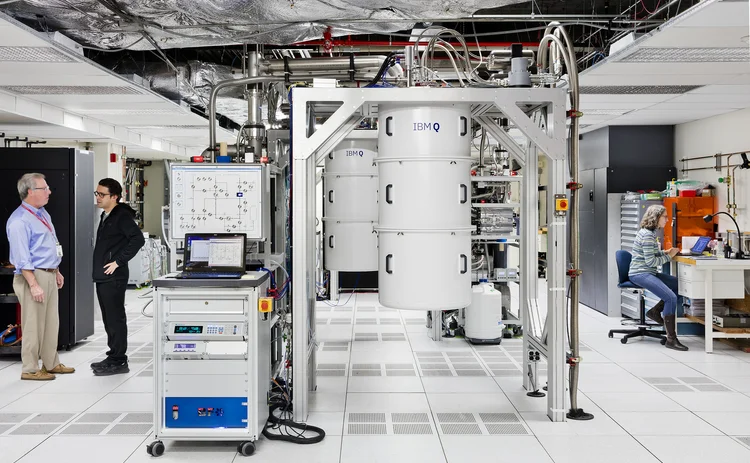

JPMorgan Chase and Barclays have joined the IBM Q Network, a collaboration of Fortune 500 companies, academic institutions and national research labs to advance quantum computing together with IBM. The network will allow them to explore and experiment with the potential and practical applications of a quantum computer via IBM Q’s early-access system.
They are the first two and only financial institutions participating in the network. The other institutions to join the IBM Q Network include Daimler AG, Samsung, JSR Corp., Hitachi Metals, Honda, Nagase, Keio University, Oak Ridge National Lab, Oxford University, and University of Melbourne.
The IBM Q Network will provide organizations with quantum expertise and resources to explore practical applications for their business and scientific research, starting with a 20 quantum bit (qubit) IBM Q system, available via the cloud.
In a statement, IBM said JPMorgan will be its “premier global financial services partner,” and will focus on use cases for quantum computing applicable to the financial industry, including trading strategies, portfolio optimization, asset pricing, and risk analysis.
Meanwhile, Barclays will build its knowledge of general approaches to quantum computing and start investigating potential use cases in finance.
Keith Bear, vice president of financial markets at IBM, tells WatersTechnology that the intention of the network is to facilitate collaboration between firms, in order to understand where the applicability of quantum computing will be in the industry they represent.
“We are now working with institutions—including the financial institutions—to better define the kinds of problems which will arguably be better solved by quantum computing or can only be solved by quantum computing,” he says, pointing to an example on the internet of a quantum calculation for the impact of Brexit on foreign-exchange markets by way of illustration.
“That’s the kind of thing that might be hard to do at a large level of scale and can be quite consuming in the amounts of technology that would be required, but can be so much more effectively done from the quantum computing point of view,” he says. “So, we are trying to find those real-world problems, be they in financial markets, like risk analysis or portfolio optimization for instance, and to translate that business problem which is better understood and known by the banks that we’re working with into a problem that could be solved in a quantum environment.”
That is where IBM sees the initial focus falling in the 20-qubit environment it is making immediately available, Bear adds.
“It comes to a point where, depending on a specific nature of calculation you’re talking about, classical computers aren’t able to fundamentally solve them because of the architecture they have,” he continues. “So it’s going to be about identifying a context in terms of financial engineers in the banks we are working with, and understanding the kinds of calculations where mathematical calculations become quantum-relevant, as it were, and be able to deploy that and learn from that exercise, which is why it’s a collaborative effort of thinking,” he says.
[For a deep dive into quantum computing’s evolution and how it may impact financial services, click here.]
Next Steps
Bear expects that in time there will be greater clarity on the use cases JPMorgan and Barclays specifically want to focus on, following the start of this engagement.
“Speaking more generally, besides the risk modeling and portfolio optimization, there are also other opportunities, for example, around the arbitrage area, which is also an optimization problem and the other one that might be interesting is on the cryptography side in the quantum-key distribution,” he says.
While the 20-qubit system is a powerful proposition for participants, IBM is already moving on to even-more powerful technology in the quantum space.
The firm recently built and measured the first working 50-qubit prototype processor, regarded as a milestone in the development of quantum computing. Bear said the intention is for Q Network participants to go beyond the 20-qubit environment currently offered and into the 50-qubit environment during a subsequent phase, to create a much higher level of scale in terms of the nature of problems that can solved at that point.
He added that there is no timescale for when IBM envisages that to happen, only that it is working on the next-generation system.
Further reading
Only users who have a paid subscription or are part of a corporate subscription are able to print or copy content.
To access these options, along with all other subscription benefits, please contact info@waterstechnology.com or view our subscription options here: https://subscriptions.waterstechnology.com/subscribe
You are currently unable to print this content. Please contact info@waterstechnology.com to find out more.
You are currently unable to copy this content. Please contact info@waterstechnology.com to find out more.
Copyright Infopro Digital Limited. All rights reserved.
As outlined in our terms and conditions, https://www.infopro-digital.com/terms-and-conditions/subscriptions/ (point 2.4), printing is limited to a single copy.
If you would like to purchase additional rights please email info@waterstechnology.com
Copyright Infopro Digital Limited. All rights reserved.
You may share this content using our article tools. As outlined in our terms and conditions, https://www.infopro-digital.com/terms-and-conditions/subscriptions/ (clause 2.4), an Authorised User may only make one copy of the materials for their own personal use. You must also comply with the restrictions in clause 2.5.
If you would like to purchase additional rights please email info@waterstechnology.com
More on Emerging Technologies
LSEG buys Octus, Tradeweb buys Trumid, Standard Chartered acquires custodian Zodia, and more
The Waters Cooler: A recap of the major tech and data news from the past week in the capital markets.

Waters Wavelength Ep. 360: Innovation, regulation, and exposure
This week, Tony and Shen talk about the balance between innovation and regulation.

Examining Google’s jump into financial research with enterprise Gemini
Google partners like Deutsche Bank and FactSet are using the offering to augment their own AI strategies.

SIX is preparing its data for clients that aren’t people
The Swiss exchange operator is betting that context and lineage will keep its market data relevant if AI agents become primary data consumers.

Barclays built a system to spot AI agents that might go rogue
Research setup ‘reads the mind’ of LLM-based agents and flags if they’re about to do something risky

AI assistants for human overseers? Or human checks and balances for AI actors?
The Waters Wrap: Speakers at a recent Bloomberg event emphasized the importance of keeping a human in the AI loop—but, Max asks, for how long?

CME marks cloud migration milestones, new FIX guidance for brokers, and more
The Waters Cooler: A recap of the major tech and data news from the past week in the capital markets.

How Quoniam boosted its sentiment strategy by adding an LLM
The asset manager’s upgraded system creates scores from more-informative forward-looking parts of news.