Metrics Man: BNY Mellon CIO Suresh Kumar
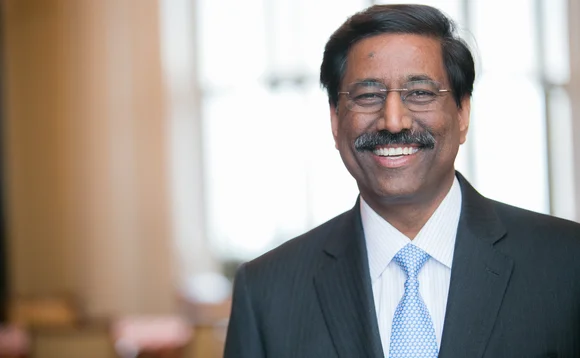
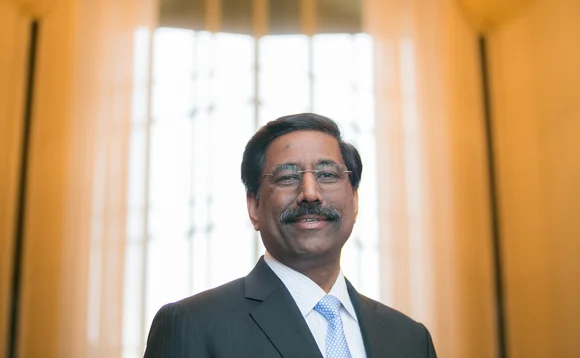

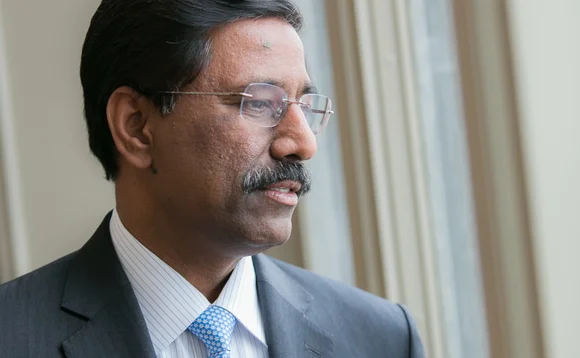
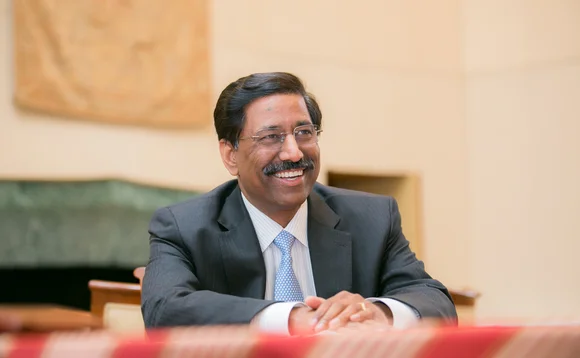
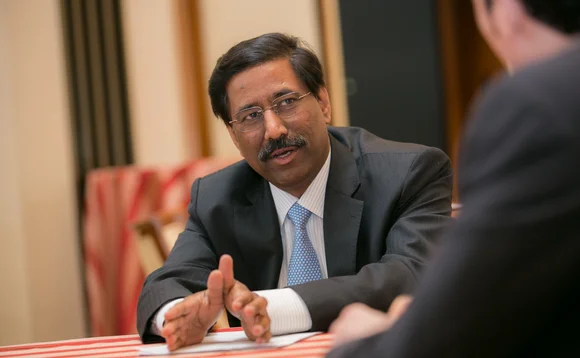

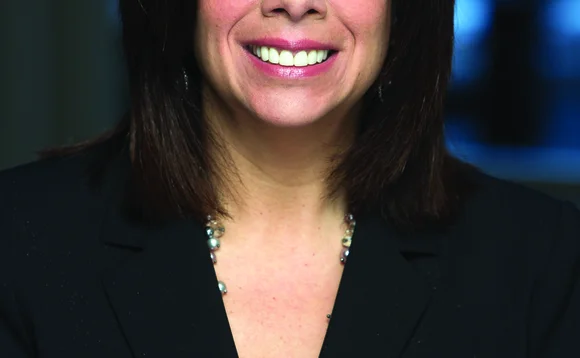
The most powerful woman in banking doesn’t impress easily, or she wouldn’t be the most powerful woman in banking. But Karen Peetz is impressed by Suresh Kumar. Just look where his career has gone since they began working together at BNY Mellon three years ago.
Peetz earned the “powerful” title from American Banker Magazine in 2011, even before she’d been appointed president of the largest custody bank in the world. Back then, she was still vice chairman in charge of financial markets and treasury services. It was the year she handed Kumar the technology reins to five businesses under her purview—corporate trust, depository receipts, broker-dealer services, treasury services, and collateral management—on top of Pershing, BNY Mellon’s clearing subsidiary, which he already ran. At the time he’d reported to her for only a year.
“He brought fresh eyes to how we were approaching problem-solving: being more client-focused, being more of a partner to the business people, and doing it in a demanding way,” says Peetz. “And I mean that in a good way—he’s the kind of person who doesn’t go away until the business people address his questions.”
Kumar was CIO at Pershing when it came under Peetz’s umbrella in 2010. She came to realize that Pershing was ahead of the rest of the company when it came to innovation, client focus, and approaching technology dynamically. She put Kumar in charge of technology for those additional divisions—comprising over 50 percent of the company—in 2011, and liked what she saw enough that, in April of 2012, he was promoted again, this time to CIO of the entire bank.
Peetz remembers the moment she realized what Kumar was capable of. Her IT team was hammering out a blueprint for a new platform meant to reduce intra-day credit risk in the tri-party repurchase agreement (repo) market, for which BNY Mellon is the largest provider of agent services. The best the team could come up with was a five-year plan that left no one satisfied. Kumar joined, and soon a two-year plan was on the table. “It was brilliant,” Peetz recalls. “Absolutely brilliant. It addressed the risk much more quickly than the five-year plan did and had more elegant features and functions.”
“We pioneered in many ways what you now see as online brokerage. We were the first ones to connect online brokerage to NYSE directly without a Series 7 holder in between, approving each order.”
A Passage From India
The Bank of New York is the oldest bank in the US, having been chartered in 1784, eight years before the New York Stock Exchange. Interestingly, its deep American roots were planted by a man born outside the US, founder Alexander Hamilton, born on the Dutch Caribbean island of Nevis. Perhaps Kumar, raised and educated in India, is not such a fish out of water at one of America’s oldest institutions.
The Indian Institutes of Technology were established in the wake of the country’s independence from British rule in 1947 to produce civil engineers that could fast-track it to the future. Kumar had that career path in mind when he enrolled in the college at Madras, one of the nation’s three best universities. While there, he was drawn to the computer lab, not because of any interest in the refrigerator-sized IBM 360s, but because it was the only room on campus besides the library with air conditioning. Nonetheless, he learned about early computing, but most importantly he learned how to learn, skills he carries with him to this day. After Madras, he earned an MBA from the Indian Institute of Management at Ahmedabad, then moved to the US shortly after graduation in 1984 to pursue his career.
Only users who have a paid subscription or are part of a corporate subscription are able to print or copy content.
To access these options, along with all other subscription benefits, please contact info@waterstechnology.com or view our subscription options here: https://subscriptions.waterstechnology.com/subscribe
You are currently unable to print this content. Please contact info@waterstechnology.com to find out more.
You are currently unable to copy this content. Please contact info@waterstechnology.com to find out more.
Copyright Infopro Digital Limited. All rights reserved.
As outlined in our terms and conditions, https://www.infopro-digital.com/terms-and-conditions/subscriptions/ (point 2.4), printing is limited to a single copy.
If you would like to purchase additional rights please email info@waterstechnology.com
Copyright Infopro Digital Limited. All rights reserved.
You may share this content using our article tools. As outlined in our terms and conditions, https://www.infopro-digital.com/terms-and-conditions/subscriptions/ (clause 2.4), an Authorised User may only make one copy of the materials for their own personal use. You must also comply with the restrictions in clause 2.5.
If you would like to purchase additional rights please email info@waterstechnology.com
More on Emerging Technologies
Firms get AI access to LSEG data via DataBP admin layer
LSEG has expanded its agreement with DataBP to enable customers’ AI-based tools to request and evaluate data from the exchange and maintain more comprehensive usage records.
Cusip, MSCI make private markets identifiers; major banks back Osera; and more
The Waters Cooler: A recap of the major tech and data news from the past week in the capital markets.

Waters Wavelength Ep. 359: GPU compute market and Sibos
This week, Shen and Nyela talk about the GPU compute market and recent technology conferences.
Rimes builds agents for exception management
The vendor aims to improve its data foundations to allow for greater agent autonomy.

How long will AI tokenomics matter?
The Waters Wrap: Banks and asset managers are rethinking the economics of AI. Wei-Shen examines how firms will manage token costs.

TT acquires Trafix in 24/7 push, T+1 deadlines in the EU loom, and more
The Waters Cooler: A recap of the major tech and data news from the past week in the capital markets.

Buy-side firms warn semantic layers not a quick fix for AI integration
Semantic layers promise to teach AI what a firm’s data means. Keeping that meaning current is the part that may get overlooked, tech heads warn.

If everyone can be an expert in everything, is anyone an expert in anything?
The Waters Wrap: AI has promised to democratize knowledge and skillsets. Reb wonders whether that’s an entirely good thing.