New Bernstein Pairs Tool Highlights Bloomberg App Portal's Rapid Maturation
Tim Bourgaize Murray chats with Vipul Nagrath and Toby Bayliss about the evolution of the firm's app program as Bernstein, AB (AllianceBernstein's) research and execution arm, has made its pairs trading tool available to Bloomberg Professional subscribers.



The app portal, launched in 2012, now features more than 80 client applications made available to Professional users, almost double the 45 with which it began.
At first attracting primarily independent analytics providers, the platform has evolved to include some of the biggest names in investment banking—including Citi, Morgan Stanley and Credit Suisse—and now brings Bernstein, which grew out of AB and provides execution for a variety of buy-side clients, into the fold with an equities pairs trading tool.
Pairs and Parameters
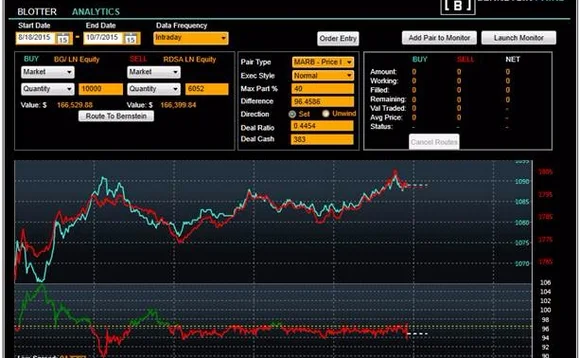
The Pairs App works by charting multiple pair spreads and projecting when they would become active based on a selected algorithmic trading style.
Orders entered in the application can then be routed to the Bernstein Pairs trading algorithms, with traders knowing when the algorithm will be active in the market. The module is targeted for both regular and merger arbitrage strategies embedded within a Bloomberg Launchpad monitor, so a trader's workflow is not disrupted.
"Entering pair trading strategies directly into an algorithm can be complex and carry a high level of risk," Bayliss, Bernstein's head of electronic trading in Europe, tells WatersTechnology. "There are many buy-side traders who previously would not enter pair trading strategies into an algorithm for fear of using the incorrect parameters."
The key with this app is that now the client can enter the parameters and see exactly when the algorithm would have been active before routing the strategy to the Bernstein algo. The charts (see sample above) quickly highlight if the algorithm will trade as expected. —Toby Bayliss, Bernstein
Indeed, proper pairs paramterization is tricky, demanding close attention to a number of considerations, he explains.
"Is the ratio entered as buy/sell or sell/buy, is the ratio in basis points or percent; how would a percentage change perform versus a straight ratio; are my deal terms entered correctly? An error in entering any one of these parameters can cause the algorithm to behave in a totally unexpected manner. The key with this app is that now the client can enter the parameters and see exactly when the algorithm would have been active before routing the strategy to the Bernstein algo. The charts (see sample above) quickly highlight if the algorithm will trade as expected."
More Horsepower
It's only one example of the app portal's speedy maturation. Nagrath, CIO for Bloomberg Enterprise Solutions and a former global head of research and development (R&D) for the company, tells Waters that many large banks and sell-side execution desks come to Bloomberg looking for "more horsepower" in the app development process.
As a result, the portal now features less static and more sophisticated apps that tap into a wider array of the functions across Bloomberg's ecosystem.
"They'll come to us knowing they've developed some unique pieces for a potential app but don't want to build it out as a standalone, so much as integrate it with Bloomberg," Nagrath says. "When firms begin thinking of apps as a unified workflow rather than a standalone analytic, completing that cycle, they see a higher chance of adoption and they also can take advantage of the flow coming back. This is why the latest set of apps, unlike the earlier set that included a licensing fee, are available without charge—because they know they can get paid in some other way."
The Pairs App, much like Citi's Total Touch block pricing application, is a good illustration of that unified workflow: It was built so that users can plug in details into the application, and once they're ready to execute, the app itself "calls" Bloomberg's EMSX execution management system via application programming interface (API) and dispatches the order. This, in part, explains why Bloomberg was happy to work with Bernstein on the project, despite offering its own pairs trading tool on EMSX.
Likewise, changes within a user's Launchpad group will also automatically reflect themselves in the app.
"You'll have a Launchpad group put together around a particular instrument, but then look to tie a new component into that group. This contextual change anywhere in the Launchpad means it will change in the app, too. So you're not running around and keeping multiple components in sync," Nagrath says. "From a programming perspective, we decided to build the portal with C# .Net language, as that is most commonly used among app developers. But we're now looking at HTML5 for the future, as we see the industry moving in that direction, even if many firms still have a large .Net base."
Perfect Marriage
Going forward, Bernstein's Bayliss says his firm sees yet more work to be done with equities using the portal.
"We'll be looking at ways we can further differentiate the Bernstein client experience when trading via EMSX," he explains. "As trading strategies become more complex and customizable, we believe the trading ticket needs to become more intuitive and interactive."
In addition, Nagrath believes the future of the app portal will see similar next-level execution tools applied to fixed income trading, as well.
With 325,000 Bloomberg Professional users, myriad subsets among them, and an everpresent demand for transparency into those markets, the impetus—and draw for potential app contributors—only grows greater, he says.
"Developers are coming to us now with apps for other asset classes, and we're definitely taking a close look at their viability," he says. "A few of them are doing things we really haven't seen before, and some of them are coming from smaller shops rather than the major banks or Bernstein. But the no-license-fee model is the trend. For us, it comes back to taking better advantage of the base elements already in our system, allowing them to build things that Bloomberg doesn't do, or to do something a little bit differently. It's about that perfect marriage."
The Bottom Line
- Sell-side execution providers, including major banks and Bernstein, are partnering with Bloomberg to provide no-license-fee applications around ever more complex trading strategies, including equity pairs.
- This second wave of apps are being provided without charge by taking greater advantage of Bloomberg's broader technology platform, creating unified trade workflows, and building new sources of revenue-generating flow.
Only users who have a paid subscription or are part of a corporate subscription are able to print or copy content.
To access these options, along with all other subscription benefits, please contact info@waterstechnology.com or view our subscription options here: https://subscriptions.waterstechnology.com/subscribe
You are currently unable to print this content. Please contact info@waterstechnology.com to find out more.
You are currently unable to copy this content. Please contact info@waterstechnology.com to find out more.
Copyright Infopro Digital Limited. All rights reserved.
As outlined in our terms and conditions, https://www.infopro-digital.com/terms-and-conditions/subscriptions/ (point 2.4), printing is limited to a single copy.
If you would like to purchase additional rights please email info@waterstechnology.com
Copyright Infopro Digital Limited. All rights reserved.
You may share this content using our article tools. As outlined in our terms and conditions, https://www.infopro-digital.com/terms-and-conditions/subscriptions/ (clause 2.4), an Authorised User may only make one copy of the materials for their own personal use. You must also comply with the restrictions in clause 2.5.
If you would like to purchase additional rights please email info@waterstechnology.com
More on Trading Tech
WatersTechnology latest edition
Check out our latest edition, plus more than 14 years of our best content.
Tech and data fragmentation irks enterprise risk managers
Often at the mercy of decisions made by other parts of the bank, ERM heads gripe at disparate systems, poor UX, and reporting gaps.

When trading systems disagree: a deterministic architecture for event sequencing
Modern trading platforms execute millions of events at extraordinary speed, but speed alone does not ensure that every downstream system shares the same view of reality, says Gaurav Tiwari.

Goldman exec: Dec. 6 a ‘lighthouse’ for EU T+1 readiness
Officials from JP Morgan, the European Central Bank, the National Securities Depository, and Goldman Sachs explained how T+1 preparation needs to be different in the EU than in the US, while speaking at Sibos.

Month-long power glitch hits key APAC trade surveillance tool
Nasdaq’s alert functions were restored, but users say testing and calibration tools were still disrupted.

Bankers question value of round-the-clock trading
BNY and State Street execs predict the arrival of extended-hours trading will come with a hefty price tag for industry firms.

BlackRock Aladdin prioritizing semantic layer for agentic AI
The asset manager’s tech platform is spending “a lot of time thinking about” semantics before it rolls out AI for a variety of tasks, says Aladdin exec.

Trading firms rethink infrastructure proximity as Asia’s FX markets grow
Firms that treat local infrastructure as core to how they serve clients in Asia stand to benefit from Singapore’s growing role as an FX hub, writes Judy Goh.